
DIRIO — file resource management

Centrally manage your file servers and SMB shares: delegate resource ownership, grant access down to a single file, move data on schedule and stay aware of every file operation.

dirio.ru — management console
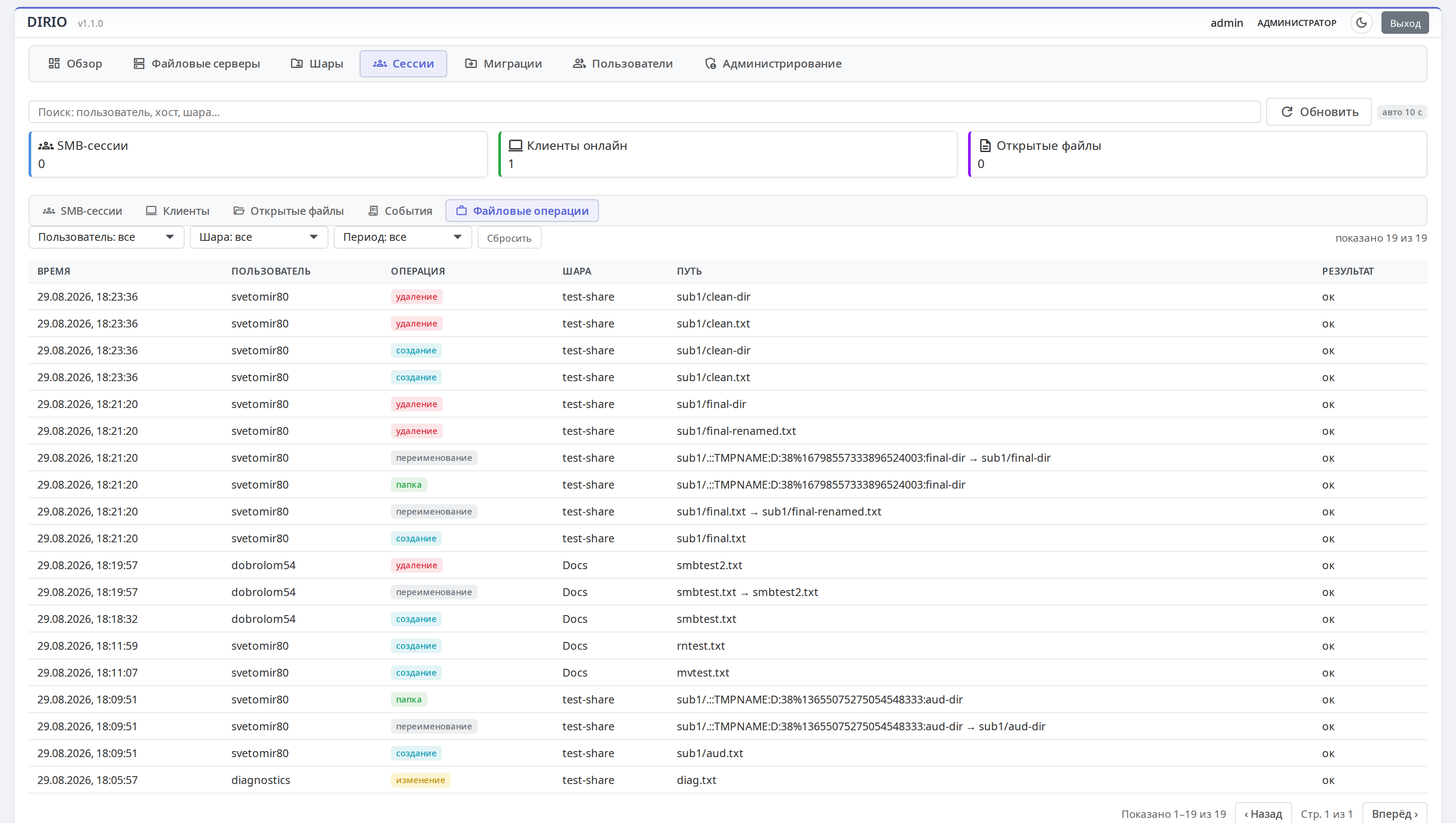
DIRIO file operation audit: who created, renamed or deleted what and when

Overview

File resources under management, not on autopilot

DIRIO is a file resource management system for corporate networks: a central console, agents on file servers, Samba with a purpose-built VFS module, and clients for workstations. Administrators manage servers, shares and permissions from one console, while resource owners manage access to "their" folders without filing IT tickets. Every grant is confirmed by a person, every operation is logged.

All features

The management console shows file servers, SMB shares, sessions and open files in real time, auto-refreshing every 10 seconds. Samba profiles are applied centrally: a common [global] section plus shares as drop-ins, validated with testparm and backed up before every application.

The administrator assigns an owner and deputies to each resource — from then on the owner manages access from the DIRIO client: they see the effective access (rules plus actual users with acceptance statuses), grant and revoke permissions, and hand ownership over to another employee. When an owner leaves, ownership is transferred in a couple of clicks.

Access can be granted to any folder or a single file inside a share — the DIRIO VFS module builds a virtual tree based on the grant policy: invisible paths never appear in directory listings, and direct access to them returns "no such file". Users see exactly what they are allowed to see.

A migration job can be scheduled for a specific time: 15 minutes before the start the resource switches to read-only, clients get notified, mounts automatically flip to read-only and back after completion. Data flows directly from source to target — the target server's agent performs the copy.

Creation, modification, deletion, rename — owners see operations on their resources in the client ("Action audit"), administrators see all shares in the console. No listing noise: only meaningful events. Every action is recorded, and the log retention depth is configurable; administrator actions live in a separate console audit journal.

Every resource — accessible shares and owned resources — is delivered to workstations by the DIRIO client. Mounted folders automatically get desktop shortcuts, the tray hosts a quick menu: one-click mounting, a jump to "My resources" (ownership), refresh from the server. Access-grant and scheduled-migration notifications arrive in the client notification center with an unread badge and are duplicated by email.

An agent's first run on a server is always in observe mode: DIRIO only inventories Samba and shows what it intends to manage. The modes observe → co-manage → full are enabled step by step, and the Drift indicator highlights any deviation from the desired state — no production surprises.

Features

Key capabilities of DIRIO

Management console

A control plane for file infrastructure: servers, shares, SMB sessions, open files and events — auto-refreshed every 10 seconds.

New

Resource owners

Every share gets an owner and deputies: delegated access management without IT tickets, ownership transfer in two clicks.

Learn more

Per-folder and per-file access

Grants on any folder or a single file inside a share. The VFS module hides everything that is not allowed: invisible paths return ENOENT.

How it works

New

Access acceptance

Users confirm access with "Accept" or decline it. Owners see statuses: accepted / declined / pending.

Notifications

Client notification center with an unread badge, pop-ups and email duplication (SMTP is configured in the console).

New

Scheduled migrations

On-schedule data migration with a read-only window: sources include Linux over SSH (rsync), SMB network folders and Windows via WinRM.

Screenshot

New

Operation audit

Real file operations — create, modify, delete, rename — without listing noise. Every action is recorded, and the log retention depth is configurable.

Screenshot

New

File manager integration

A "DIRIO permissions" context menu in Nautilus (GNOME) and Dolphin (KDE) — grant access right from the file browser.

Agents and desired state

Agents register with the server, send heartbeats and apply the desired state. The Drift indicator exposes deviations.

Workstation client

The single delivery point for resources: a tray GUI and a CLI, automatic desktop shortcuts, access and migration notifications, silent re-mount after outages.

Screenshot
Also included: drop-in Samba profiles· Samba inventory· read-only migration window· ownership handover when owners leave· console dark theme· REST API

Integrations

Fits into your IT environment

Directory & SSO

MS AD · FreeIPA · ALD Pro

LDAP sources: single sign-on for administrators, roles bound to directory nodes (OUs/groups) and dynamic collections.

Client authentication

Kerberos

SPNEGO for clients and sec=krb5i mounts — share access via domain tickets, no stored passwords.

Monitoring

SIEM

Export of access events and administrator actions: Syslog RFC 5424 (UDP/TCP/TLS) and HTTP webhook — KUMA, MaxPatrol, Splunk.

Desktop

Nautilus · Dolphin

dirio-fm-gnome and dirio-fm-kde packages: a "DIRIO permissions" context menu in GNOME and KDE.

Architecture

Console, agents, VFS-enabled Samba and clients

The central server (control plane) manages agents on file servers and a Samba container with a purpose-built VFS module. Workstation clients mount shares via Kerberos and talk to the console over HTTPS.

Management console (control plane) File server agents Samba + DIRIO VFS module
SMB mounting and HTTPS API access
Workstation clients (tray · CLI · file managers)

An existing Samba server connects through the agent — no container, no reinstall.

Center

dirio-server

The control plane: web console and HTTPS API, PostgreSQL, RBAC roles, LDAP directory, migration scheduler and audit journals.

  • Console: servers, shares, sessions, migrations
  • RBAC with LDAP role binding
  • Docker deployment from deb/rpm
Host

dirio-agent-linux

A systemd service on the file server: registers with the console, sends heartbeats, inventories Samba and applies the desired state.

  • observe / co-manage / full modes
  • smb.conf backup and testparm before reload
  • Executes data migration jobs
Data

dirio-samba

Turnkey Samba in a container: smbd, the vfs_dirio VFS module (C) and a dirio-authz service authorizing sessions over a Unix socket.

  • Virtual tree driven by grant policy
  • Hidden paths return ENOENT
  • Fail-closed: no authz answer, no access

Phased rollout

An agent's first run is always in observe mode. Then co-manage (managed shares alongside manual ones) and full. The Drift indicator reveals deviations from the desired state in advance.

Migrating from SUFR

A ready-made script migrates a live SUFR installation to DIRIO: database, OS user, systemd units and paths. It is idempotent and can be run repeatedly.

Security

Access under control, every action on the record

SIEM

event export: Syslog RFC 5424 (UDP/TCP/TLS) and HTTP webhook — KUMA, MaxPatrol, Splunk.

100%

of console and API traffic over HTTPS. Clients use Kerberos SPNEGO; mounts use sec=krb5i.

0

default grants: fail-closed VFS plus an explicit "Accept" confirmation from the user.

An agent's first run on a file server is always in observe mode: DIRIO changes nothing until you switch the server to co-manage or full.

Platform protection

  • RBAC and LDAP

    Roles with a permission matrix, binding to directory nodes (OUs/groups) and dynamic filter collections.

  • Invisible without access

    The VFS hides forbidden paths from readdir, and direct access returns ENOENT — the share structure is never revealed.

  • Fail-closed authorization

    VFS sessions are authorized by dirio-authz over a Unix socket: if the service is unreachable, access is denied.

  • Encrypted secrets

    Migration source passwords are encrypted (Fernet) and never appear in job logs.

  • Audit journal

    Every action is recorded: user file operations and administrator actions; log retention depth is configurable.

  • SIEM export

    Syslog RFC 5424 (UDP/TCP/TLS) and HTTP webhook: KUMA, MaxPatrol, Splunk.

Screenshots

The DIRIO interface

Frequently asked questions

DIRIO is a corporate file resource management system: a central console (control plane), agents on file servers, Samba with a purpose-built VFS module, and workstation clients. It replaces scattered smb.conf files and IT tickets with a transparent process: every resource has an owner, every grant has a confirmation, every operation has a log entry.

The console administrator assigns an owner and deputies to a resource — assignees receive a notification. The owner then uses the DIRIO client ("My resources" tab) to see the effective access: rules plus actual users with their acceptance statuses. They edit rules, grant access to any folder or a single file, and can hand ownership to another employee while staying a deputy. Every change lands in the console audit journal.

The user gets a notification in the client and by email with a choice: "Accept" (confirm access) or "Decline" (the grant is deactivated). Access is active immediately, and the owner sees its status. A decline applies to the whole resource and survives rule edits; re-granting asks for confirmation again.

Yes. The DIRIO VFS module builds a virtual tree from the grant policy: rules can point to any path inside a share. Invisible names are hidden from directory listings (readdir), and direct access to a forbidden path returns "no such file" (ENOENT) — the user never learns that someone else's data exists.

A job can be started manually or on schedule. 15 minutes before the start the resource switches to read-only: clients are notified, the resource icon shows a lock, and mounts automatically flip to read-only — and back after completion. The target server's agent performs the copy, so data flows directly from source to target. Supported sources: Linux over SSH (rsync), SMB network folders and Windows via WinRM with a temporary share; dry-run, ACL/xattr transfer and rate limits are available.

Server and agents ship as deb packages (Astra Linux, Debian, Ubuntu) and rpm (RED OS, RHEL); the console deploys to Docker. Clients are Linux: a CLI, a tray GUI (PyQt5) and Nautilus/Dolphin integration; Astra's fly file browser is supported. User directories: MS AD, FreeIPA, ALD Pro; client authentication uses Kerberos (SPNEGO) with sec=krb5i mounts. Windows packages are on the way.

Yes. The dirio-agent-linux agent installs on an existing server without any container: it inventories Samba and, in co-manage/full modes, manages shares through central profiles. Every application is preceded by an smb.conf backup and a testparm check, and the first run is always in observe mode. There is also a script for migrating a live SUFR installation to DIRIO (database, OS user, systemd, paths).

The console and API run over HTTPS only; administrators sign in via LDAP (AD, FreeIPA, ALD Pro) with an RBAC permission matrix. VFS sessions are authorized by the dirio-authz service over a Unix socket in fail-closed mode: no answer, no access. Migration source passwords are encrypted (Fernet). Journals cover file operations and administrator actions — retention depth is configurable, and events are exported to SIEM.

Next steps

Bring order to your file resources

We will show DIRIO on a demo stand — the console, delegated ownership, migrations and audit — or discuss a pilot on your own file servers, starting in observe mode with zero production changes.

Demonstration

An online tour of the console and clients on our demo stand, with answers to your architecture and security questions.

Write to info@dirio.ru

Pilot deployment

We will connect your file servers in observe mode and show the real picture: shares, sessions, Drift.

Discuss a pilot

Or directly: info@dirio.ru · +7 995 437-14-87